 Add to Chrome
 Add to Firefox
 Add to Edge
Spectral Anatomy of Quantum Gaussian Process Kernels
May 29, 2026
Two recent results have reshaped quantum Gaussian processes (QGPs). On the one hand, \citet{lowe2025assessing} rule out the exponential speedups claimed by HHL-based QGP regression in the typical, well-conditioned regime; on the other, an independent line of work shows that highly expressive quantum kernels suffer posterior pathologies that break Bayesian optimization. We show that these seemingly unrelated phenomena are governed by the same quantity: the normalized spectral entropy $S(K)/\log n$ of the kernel Gram matrix. We prove a Cauchy--Schwarz tail bound on Nyström approximation error, a finite-sample variance-contraction identity in terms of Bach's degrees of freedom $d_σ(K)$, and a characterization of the \emph{target-dependent} optimal entropy via the intrinsic dimension of the target in the kernel eigenbasis. Empirically, the diagnostic is kernel-agnostic: hardware-efficient, matchgate, IQP \emph{and} RBF/Matérn/RFF/deep-kernel families all collapse onto identical $S/\log n$ curves on dequantization, ECE, and variance-contraction panels. The NLL sweet spot lives at high entropy for smooth targets and at low entropy for band-limited quantum-data targets. The diagnostic transfers from simulator to IBM Heron hardware with median absolute error $3.2\%$ and mean $5.2\%$ in $S/\log n$ across $24$ configurations at $n_q = 4$, with matchgate and IQP within $5\%$ mean and a single HE configuration returning a $30\%$ outlier that drops to $0.5\%$ on rerun (attributed to calibration drift); the same diagnostic transfers to a second Heron backend (mean error $2.7\%$) and to a $n_q = 6$ scale-up on the original backend (mean error $1.7\%$). No error mitigation is applied throughout.

Onsager-Machlup Posterior Transport for Deep Gaussian Processes
May 22, 2026Approximate inference over inducing variables is the central computational bottleneck of Deep Gaussian Processes (DGPs). Existing methods either fit an explicit density $q_φ(\bU)$ by an ELBO (DSVI, IPVI, DDVI, DBVI) or sample by MCMC (SGHMC). We instead frame DGP inference as \emph{posterior transport}: learn a deterministic sampler that maps a tractable reference measure to posterior-relevant inducing variables, regularised by a path prior derived from the Doob-bridged reference diffusion. Our realisation, \textbf{OM-Path} (formally FBVI-bridge-Path), uses Song's probability-flow ODE applied to DBVI's Doob-bridged forward SDE; the reference drift is closed-form from the bridge marginal coefficients (no score matching) and the path regulariser is the \textbf{Onsager--Machlup action}. At the finite-$ε$ value used at training, the objective is the negative log unnormalised density of a tempered Doob-bridge path posterior, and Theorem 1 identifies it with the same posterior's small-noise MAP path via the Freidlin--Wentzell LDP. Two strict path-space ELBO variants on the same bridge backbone (FFJORD log-det; OM-regularised CNF) are derived as ablations. Under a matched-seed paired Wilcoxon test against DBVI on seven UCI regression benchmarks, OM-Path delivers statistically significant wins on the two largest datasets (\textit{power}: $p\!=\!0.014$, NLL $\mathbf{0.012}$ matching the DSVI baseline of $0.017$; \textit{protein}: $p\!=\!0.002$, RMSE $\mathbf{0.716}$ vs.\ $0.764$, NLL $\mathbf{1.086}$ vs.\ $1.149$), statistical ties on \textit{yacht} / \textit{qsar}, and concedes \textit{boston} / \textit{energy} / \textit{concrete} to DBVI on small-$N$ noisy data. The strict-ELBO variants do not clear DBVI on any UCI metric: in this regime, reducing the variance of the path objective dominates exact-density tracking.
AQKA: Active Quantum Kernel Acquisition Under a Shot Budget
May 14, 2026Estimating an $N \times N$ quantum kernel from circuit fidelities requires $Θ(N^2 S)$ measurement shots, the dominant bottleneck for deployment on near-term hardware. Existing budget-saving methods (Nyström-QKE, ShoFaR, kernel-target alignment) sub-sample \emph{which} entries to measure but allocate shots \emph{uniformly} within their chosen subset, ignoring how much each entry drives the downstream classifier. We close this gap with two contributions. \textbf{First, a complete regime decomposition} for shot-budgeted quantum kernel learning: a principled menu of when each allocator wins. Our method, \emph{AQKA}, dominates the budget-limited regime ($B \lesssim 16 n_{\mathrm{pairs}}$) on sparse-sensitivity KRR, with the gap \emph{growing} from $+8$ to $+25$ pts over uniform as $N$ scales $225{\to}1000$ and reaching $+26$--$32$ pts on an \texttt{ibm\_pittsburgh} (156-qubit Heron) hardware kernel; Nyström-QKE wins at saturating budgets on planted-sparse via low-rank reconstruction; ShoFaR is competitive only at extreme low budgets. \textbf{Second, a closed-form pair-level acquisition theory}: $s_{ij}^{\star} \propto |g_{ij}|\sqrt{K_{ij}(1-K_{ij})}$ with explicit gradient $g_{ij}$ for KRR (Lemma~1, $|β_iα_j+β_jα_i|\sqrt{K_{ij}(1-K_{ij})}$) and SVM via the envelope theorem ($|η_i^*η_j^*|\sqrt{K_{ij}(1-K_{ij})}$); a \emph{corrected} sparsity-aware Cauchy--Schwarz rate $ρ\le 2m/N$ matching empirics (vs.\ the naive $m^2/N^2$); an explicit-constant plug-in regret bound (Theorem~2); and a tighter SVM ceiling $ρ^{\mathrm{SVM}} \le m_{\mathrm{sv}}^2/N^2$. We close with the first multi-seed live online adaptive shot allocation on quantum hardware: $+17.0 \pm 4.8$ pts at $N{=}20$ on \texttt{ibm\_aachen} ($3.5σ$, 5 seeds), with the advantage holding at $N{=}30$ at higher budget on \texttt{ibm\_berlin} ($+14.0 \pm 8.5$ pts, 5 seeds).
Stochastic Schrödinger Diffusion Models for Pure-State Ensemble Generation
May 05, 2026In quantum machine learning (QML), classical data are often encoded as quantum pure states and processed directly as quantum representations, motivating representation-level generative modeling that samples new quantum states from an underlying pure-state ensemble rather than re-preparing them from perturbed classical inputs. However, extending \emph{score-based} diffusion models with well-defined reverse-time samplers to quantum pure-state ensembles remains challenging, due to the non-Euclidean geometry of the complex projective space $\mathbb{CP}^{d-1}$ and the intractability of transition densities. We propose \emph{Stochastic Schrödinger Diffusion Models} (SSDMs), an intrinsic score-based generative framework on $\mathbb{CP}^{d-1}$ endowed with the Fubini--Study (FS) metric. SSDMs formulate a forward Riemannian diffusion with a stochastic Schrödinger equation (SSE) realization, and derive reverse-time dynamics driven by the Riemannian score $\nabla_{\mathrm{FS}} \log p_t$. To enable training without analytic transition densities, we introduce a local-time objective based on a local Euclidean Ornstein--Uhlenbeck approximation in FS normal coordinates, yielding an analytic teacher score mapped back to the manifold. Experiments show that SSDMs faithfully capture target pure-state ensemble statistics, including observable moments, overlap-kernel MMD, and entanglement measures, and that SSDM-generated quantum representations improve downstream QML generalization via representation-level data augmentation.
Towards Disentangled Preference Optimization Dynamics Beyond Likelihood Displacement
Apr 20, 2026Preference optimization is widely used to align large language models (LLMs) with human preferences. However, many margin-based objectives suppress the chosen response along with the rejected one, a phenomenon known as likelihood displacement, and no general mechanism currently prevents this across objectives. We bridge this gap by presenting a unified \emph{incentive-score decomposition} of preference optimization, revealing that diverse objectives share identical local update directions and differ only in their scalar weighting coefficients. Building on this decomposition, by analyzing the dynamics of the chosen/rejected likelihoods, we identify the \emph{disentanglement band} (DB), a simple, testable condition that characterizes when training can avoid likelihood displacement by realizing the preferred pathway: suppressing the loser while maintaining the winner, possibly after an initial transient. Leveraging the DB, we propose a plug-and-play \emph{reward calibration} (RC) that adaptively rebalances chosen versus rejected updates to satisfy the DB and mitigate likelihood displacement, without redesigning the base objective. Empirical results show that RC steers training toward more disentangled dynamics and often improves downstream performance across a range of objectives. Our code is available at https://github.com/IceyWuu/DisentangledPreferenceOptimization.
One-Step Score-Based Density Ratio Estimation
Apr 12, 2026Density ratio estimation (DRE) is a useful tool for quantifying discrepancies between probability distributions, but existing approaches often involve a trade-off between estimation quality and computational efficiency. Classical direct DRE methods are usually efficient at inference time, yet their performance can seriously deteriorate when the discrepancy between distributions is large. In contrast, score-based DRE methods often yield more accurate estimates in such settings, but they typically require considerable repeated function evaluations and numerical integration. We propose One-step Score-based Density Ratio Estimation (OS-DRE), a partly analytic and solver-free framework designed to combine these complementary advantages. OS-DRE decomposes the time score into spatial and temporal components, representing the latter with an analytic radial basis function (RBF) frame. This formulation converts the otherwise intractable temporal integral into a closed-form weighted sum, thereby removing the need for numerical solvers and enabling DRE with only one function evaluation. We further analyze approximation conditions for the analytic frame, and establish approximation error bounds for both finitely and infinitely smooth temporal kernels, grounding the framework in existing approximation theory. Experiments across density estimation, continual Kullback-Leibler and mutual information estimation, and near out-of-distribution detection demonstrate that OS-DRE offers a favorable balance between estimation quality and inference efficiency.
Don't Forget Its Variance! The Minimum Path Variance Principle for Accurate and Stable Score-Based Density Ratio Estimation
Jan 31, 2026Score-based methods have emerged as a powerful framework for density ratio estimation (DRE), but they face an important paradox in that, while theoretically path-independent, their practical performance depends critically on the chosen path schedule. We resolve this issue by proving that tractable training objectives differ from the ideal, ground-truth objective by a crucial, overlooked term: the path variance of the time score. To address this, we propose MinPV (\textbf{Min}imum \textbf{P}ath \textbf{V}ariance) Principle, which introduces a principled heuristic to minimize the overlooked path variance. Our key contribution is the derivation of a closed-form expression for the variance, turning an intractable problem into a tractable optimization. By parameterizing the path with a flexible Kumaraswamy Mixture Model, our method learns a data-adaptive, low-variance path without heuristic selection. This principled optimization of the complete objective yields more accurate and stable estimators, establishing new state-of-the-art results on challenging benchmarks.
Any-Step Density Ratio Estimation via Interval-Annealed Secant Alignment
Sep 05, 2025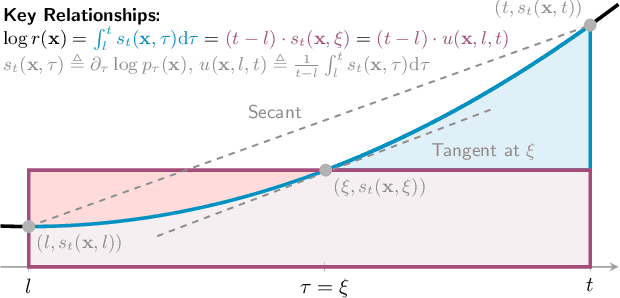

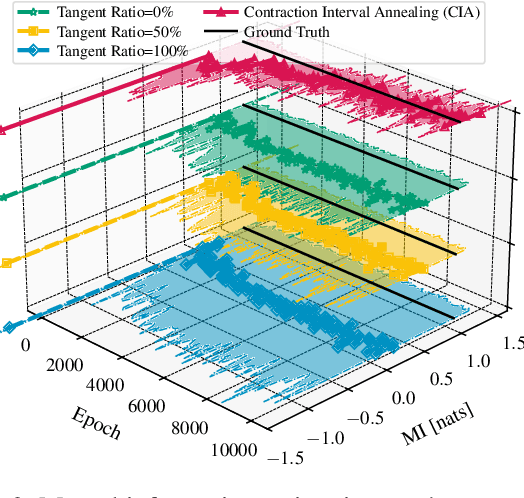
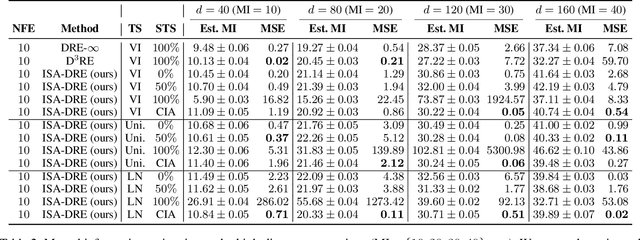
Estimating density ratios is a fundamental problem in machine learning, but existing methods often trade off accuracy for efficiency. We propose \textit{Interval-annealed Secant Alignment Density Ratio Estimation (ISA-DRE)}, a framework that enables accurate, any-step estimation without numerical integration. Instead of modeling infinitesimal tangents as in prior methods, ISA-DRE learns a global secant function, defined as the expectation of all tangents over an interval, with provably lower variance, making it more suitable for neural approximation. This is made possible by the \emph{Secant Alignment Identity}, a self-consistency condition that formally connects the secant with its underlying tangent representations. To mitigate instability during early training, we introduce \emph{Contraction Interval Annealing}, a curriculum strategy that gradually expands the alignment interval during training. This process induces a contraction mapping, which improves convergence and training stability. Empirically, ISA-DRE achieves competitive accuracy with significantly fewer function evaluations compared to prior methods, resulting in much faster inference and making it well suited for real-time and interactive applications.
Neural Bridge Processes
Aug 10, 2025Learning stochastic functions from partially observed context-target pairs is a fundamental problem in probabilistic modeling. Traditional models like Gaussian Processes (GPs) face scalability issues with large datasets and assume Gaussianity, limiting their applicability. While Neural Processes (NPs) offer more flexibility, they struggle with capturing complex, multi-modal target distributions. Neural Diffusion Processes (NDPs) enhance expressivity through a learned diffusion process but rely solely on conditional signals in the denoising network, resulting in weak input coupling from an unconditional forward process and semantic mismatch at the diffusion endpoint. In this work, we propose Neural Bridge Processes (NBPs), a novel method for modeling stochastic functions where inputs x act as dynamic anchors for the entire diffusion trajectory. By reformulating the forward kernel to explicitly depend on x, NBP enforces a constrained path that strictly terminates at the supervised target. This approach not only provides stronger gradient signals but also guarantees endpoint coherence. We validate NBPs on synthetic data, EEG signal regression and image regression tasks, achieving substantial improvements over baselines. These results underscore the effectiveness of DDPM-style bridge sampling in enhancing both performance and theoretical consistency for structured prediction tasks.
Dequantified Diffusion Schrödinger Bridge for Density Ratio Estimation
May 08, 2025Density ratio estimation is fundamental to tasks involving $f$-divergences, yet existing methods often fail under significantly different distributions or inadequately overlap supports, suffering from the \textit{density-chasm} and the \textit{support-chasm} problems. Additionally, prior approaches yield divergent time scores near boundaries, leading to instability. We propose $\text{D}^3\text{RE}$, a unified framework for robust and efficient density ratio estimation. It introduces the Dequantified Diffusion-Bridge Interpolant (DDBI), which expands support coverage and stabilizes time scores via diffusion bridges and Gaussian dequantization. Building on DDBI, the Dequantified Schr\"odinger-Bridge Interpolant (DSBI) incorporates optimal transport to solve the Schr\"odinger bridge problem, enhancing accuracy and efficiency. Our method offers uniform approximation and bounded time scores in theory, and outperforms baselines empirically in mutual information and density estimation tasks.